
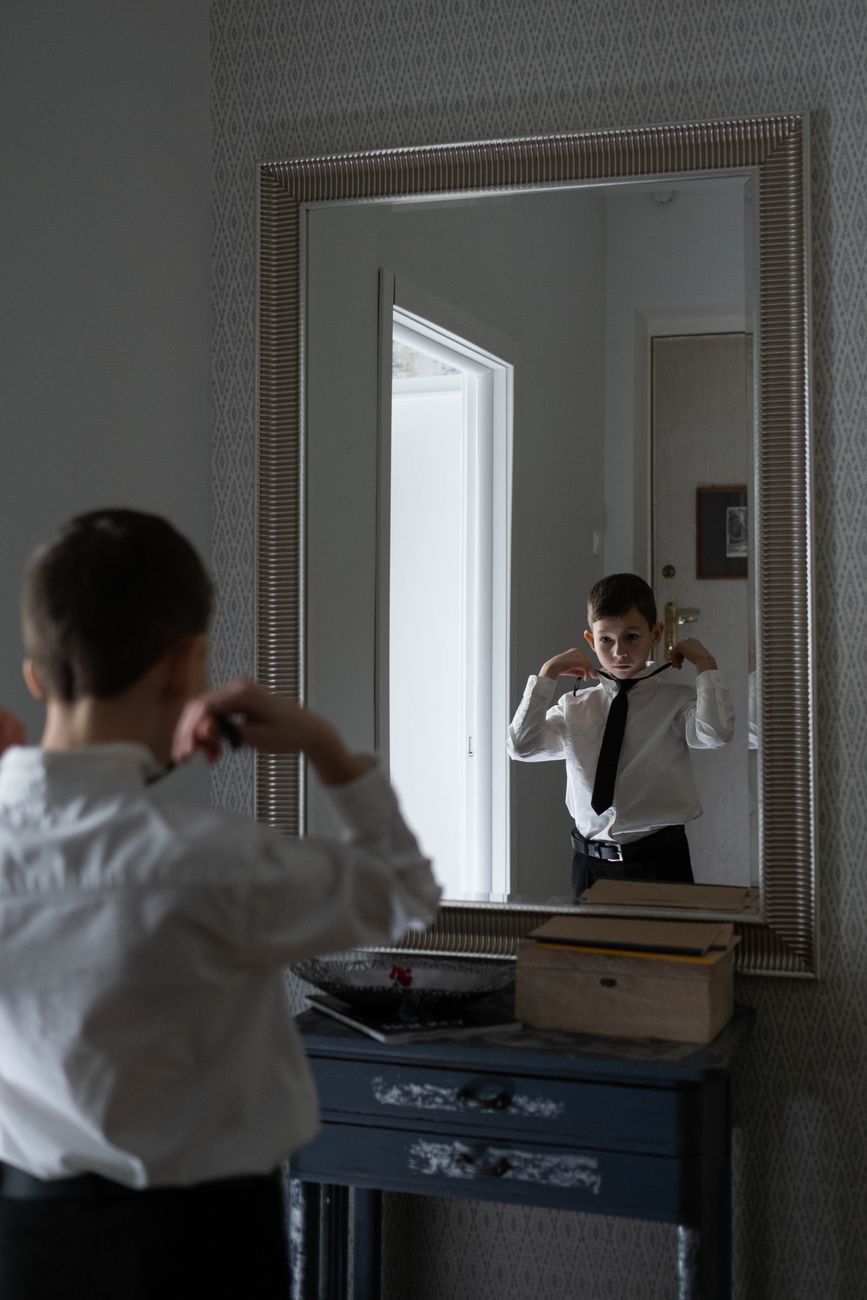
On getting dressed as an act of self-knowledge – not performance
(5 Minutes)
Every morning, before the world gets any say in who you are, there is a quiet moment. It happens in a closet, or in front of a mirror, or sometimes just in the pause before you reach for the first thing you find. It is small. It is ordinary. Most of us move through it without thinking.
But it is actually one of the most honest moments of the day.
What you choose to put on before anyone else sees you — before the meeting, before the school run, before the commute — is a conversation you are having with yourself. Not about fashion. Not about what’s trending or what’s appropriate or what will land well in the room. A conversation about who you are today, and how you want to carry that into the world.
Most of us have never thought about it that way. But we feel it. We all feel it.
You know the difference immediately
Think about the last time you got dressed in a way that felt genuinely right. Not dressed up, necessarily. Not expensive or elaborate. Just — right. The fit, the color, the weight of the fabric against your skin. Everything quiet and settled. You walked out the door and something in you was already organized before the day had a chance to disorganize it.
Now think about the last time you grabbed whatever was there because you were running late, or because you couldn’t find the thing you actually wanted, or because you talked yourself out of the version you really wanted to wear and settled for the safer one. You know how that felt too. A low-grade friction that followed you into the morning. Nothing dramatic. Just slightly off. Slightly not quite yourself.
That difference — between the two mornings — is not vanity. It is not superficiality. It is the difference between starting the day in alignment with yourself and starting it slightly sideways. And it compounds. The version of you that walks into the room feeling settled and true is a different version than the one who walked in already managing a small internal gap between who they are and how they appear.
What the research quietly confirms
Psychologists have a term for this: enclothed cognition. The concept suggests that clothing affects not just how others perceive us but how we think, feel, and behave — that wearing something that carries meaning to us can genuinely shift our confidence, our focus, and the way we move through the world.
But there is something even more interesting underneath the research. The act of dressing for a role is, in part, the act of constructing the self that will inhabit that role. A person who dresses with care for a demanding professional context is not simply attending to appearance — they are organizing themselves. They are, in a real psychological sense, assembling the version of themselves suited to that context.
Read that again slowly. Assembling the version of themselves. Not performing it. Not projecting it. Assembling it — the way you would prepare anything you intend to use well.
Getting dressed, when done with even a small amount of intention, is not a cosmetic act. It is a preparatory one. It is how you show up to yourself before you show up to anything else.
The private conversation versus the public performance
Here is where it gets interesting — and where most of the conversation about clothing gets it slightly wrong.
We tend to talk about style as if it is primarily outward. As if the point of what you wear is the impression it makes on other people. And yes, clothes communicate. They always have. They sit at the intersection of identity, culture, aspiration, and habit — personal, but also shaped by broader narratives: media cycles, economic moods, workplace norms, social expectations. That is real and it matters.
But the most honest dressers — the people who have a genuine relationship with how they present themselves — are not primarily dressing for the room. They are dressing for themselves first. The room is secondary. What they put on in the morning is the private conversation. What other people see is just the echo of it.
This distinction is everything. Because when you dress primarily for the room — for the approval, for the legibility, for the version of yourself that lands most easily — you are doing the same thing we talked about with over-explaining yourself. You are managing your edges. Making yourself more readable. And in doing so, you are starting the day slightly away from yourself rather than inside yourself.
The person who dresses from the inside out carries something different into the room. Not necessarily more impressive. Not louder or more striking. Just more settled. More present. More fully themselves. And people feel that, even when they can’t name it.
Why most of us don’t do this
Because it requires knowing yourself well enough to know what feels true. And that is harder than it sounds.
Most of us dress from a combination of habit, convenience, social expectation, and the accumulated weight of what we think we’re supposed to look like given our age, our role, our context, our body. We dress from the outside in — starting with what’s acceptable and working backward toward something that might also feel like us. On a good day, those two things overlap. On most days, there is a gap.
Closing that gap is not a shopping problem. It is a self-knowledge problem. You cannot dress in a way that feels true if you haven’t done the quieter work of knowing what true feels like for you. What fits not just your body but your actual sense of self. What carries the right weight — not in terms of formality, but in terms of intention. What you reach for when nobody has any expectations and you are dressing only for yourself.
That version — the one you’d wear if no one were watching — is the most honest data point you have about your own sense of self. Most people never pay attention to it.
Craft as a form of respect
There is one more thing worth saying here, and it connects to something deeper than style.
When something is made well — genuinely well, with attention to the detail that most people will never notice — it carries that intention into every moment it is worn. A shirt that fits the way it is supposed to fit, cut for an actual body rather than a generic one, made from fabric chosen for how it holds and moves and wears over time — that object is not neutral. It is the physical expression of someone caring enough to do the thing properly. To not take shortcuts where shortcuts would have been easy and invisible.
Wearing something like that is not about status. It is about alignment. Between the care that went into making it and the care you bring to showing up as yourself. Between the intention behind the object and the intention you carry into your day.
This is what craftsmanship has always been about, underneath the aesthetics. Not beauty for its own sake — though beauty matters — but the refusal to be careless with something that deserves attention. The insistence that some things are worth doing all the way, even in the places where nobody will ever see the difference except you.
And you will see it. Every morning, in that quiet moment before the world gets any say. You will feel whether what you’re putting on was made with care or without it. Whether it was chosen for you or just chosen. Whether it closes the gap between who you are and how you appear — or widens it.
That gap, small as it is, is where the day begins.
An invitation
Pay attention to that moment tomorrow morning. Not as a style exercise. Not as a shopping list. Just — notice what you reach for, and ask yourself honestly whether it’s the truest version of how you want to meet the day. Whether the conversation you’re having with yourself in that quiet moment is one of intention or habit.
You don’t have to overhaul anything. You just have to start noticing. Because the people who dress with genuine intention — who have done the work of knowing what feels true and have found the things that carry that truth well — are not better dressed in the way magazines mean. They are more themselves. And being more yourself, consistently, from the first quiet moment of the morning, is one of the most underrated forms of grit there is.
How you dress when nobody is watching is one of the most honest things about you. Pay attention to it.


Leave a comment