
On the small moments the world offers — and the permission to actually receive them
(6 Minutes)
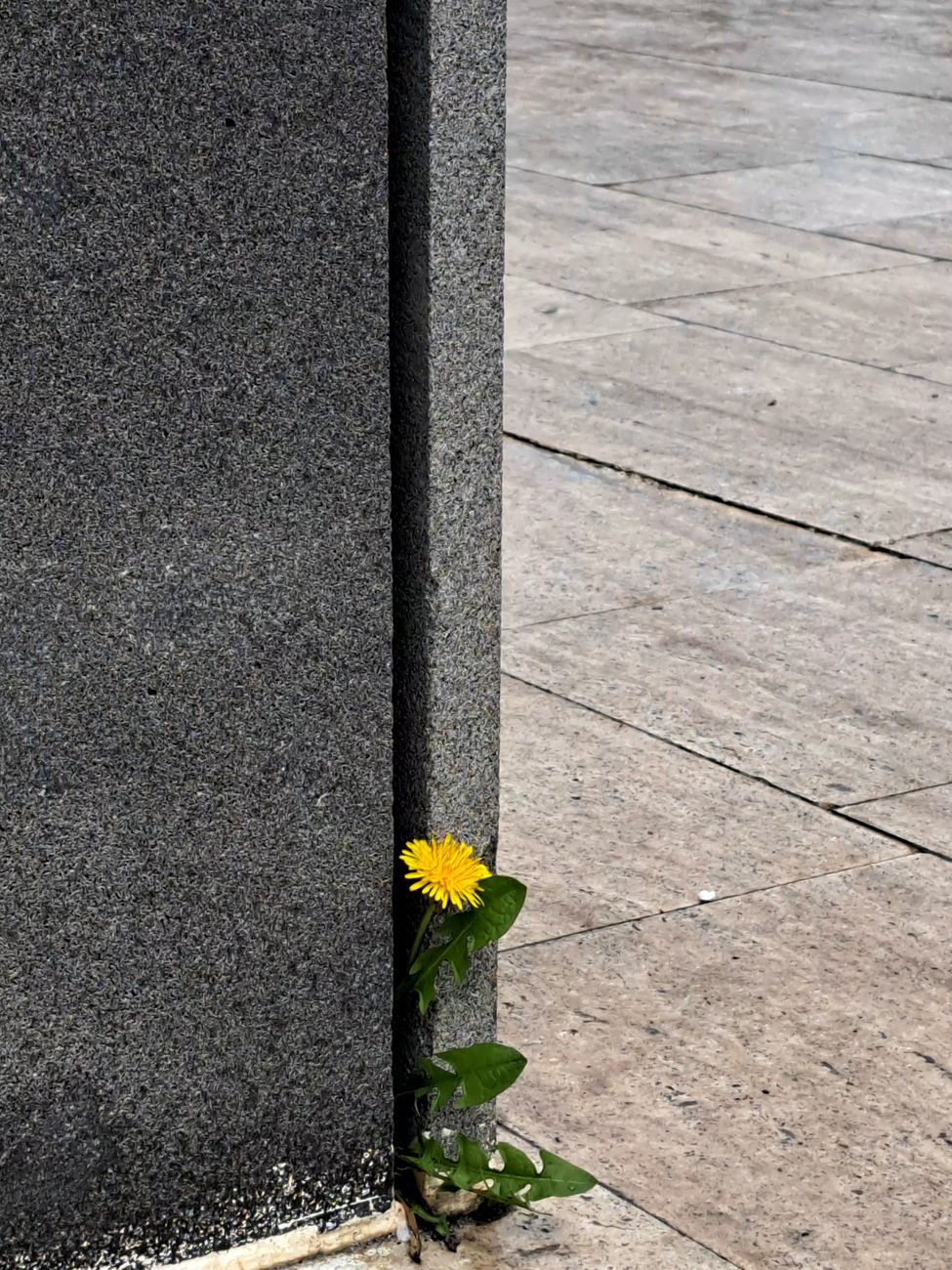
There was a dandelion growing out of a crack in the pavement.
Not in a garden. Not somewhere it was supposed to be. Just — there. In the gap between the sidewalk and the curb, in a city that has very little patience for things that grow without permission, a dandelion had decided to exist anyway. Yellow and completely certain of itself.
You probably walked past something like it this week. You may have noticed it for a fraction of a second — a small yellow interruption in the grey — and then continued. The meeting was in twelve minutes. The coffee was getting cold. The thing you were thinking about before you saw the dandelion reasserted itself immediately, the way things do when we have trained our attention to keep moving.
But there was a moment. A fraction of one, maybe. Where something in you registered it.
This is about that moment. And about what it might mean to stay in it — just slightly longer than we usually allow ourselves to.
The world offers these things constantly. Not dramatically. Not in ways that announce themselves or demand attention. Quietly, at the margins of ordinary days, in the spaces between the things we are managing.
A stranger holds a door open and makes eye contact and smiles — not the performed smile of customer service but a real one, the kind that reaches the eyes, the kind that means nothing except that two people briefly acknowledged each other’s existence and found it acceptable. A cool breeze arrives on a hot afternoon with the specific timing of something that was sent rather than random. A child laughs somewhere nearby — unseen, pure, the kind of laugh that has not yet learned to be self-conscious. A song comes on that you had forgotten you knew and suddenly you are somewhere else for four seconds, somewhere earlier and simpler, before the song ends and you return.
These are not significant events. Nobody would include them in an account of the day. And yet something happens in them — something small and real and easily missed — that is worth paying attention to.
What happens, specifically, is a kind of interruption.
Not an unwelcome one. A gentle one. The world reaching through the film of preoccupation that most of us move through most of the time and making brief contact with the part of you that is still alive to things. Still permeable. Still capable of being moved by something that was not on the agenda.
Psychologists who study these moments — they call them micro-restorative experiences, which is a clinical way of saying: small things that give something back. Brief encounters with beauty or kindness or the unexpected that restore, in tiny increments, something that the relentlessness of ordinary life quietly depletes. The capacity for wonder. The sense that the world is larger than your to-do list. The feeling of being, however briefly, surprised.
The research on these moments is clear and slightly humbling. They are genuinely good for you. Not in a vague wellness-content way — measurably, physiologically good. A brief exposure to natural beauty lowers cortisol. A small act of unexpected kindness received produces a mild oxytocin response. The dandelion in the crack of the pavement is, in the most literal biological sense, medicine.
But only if you stop long enough to receive it.
This is the harder part. Because stopping — even for five seconds, even for the duration of a dandelion — requires something that most of us have been quietly trained out of.
It requires permission.
Not from anyone else. From yourself. The internal permission to pause the forward motion of the day and be where you are for a moment. To let something small matter. To feel the breeze and acknowledge that you felt it rather than filing it immediately under irrelevant and moving on.
This sounds simple. It is not simple. It runs directly against the logic of productivity, of efficiency, of the particular value system that measures a day by what was accomplished rather than what was received. In that system, stopping for a dandelion is a small failure of momentum. A distraction. Something to be noted briefly and moved past.
In another system — one that measures a day by how fully it was inhabited rather than how efficiently it was processed — stopping for the dandelion is not a distraction. It is the point.
I want to suggest something gently, because it is not the kind of thing that responds well to being said loudly.
You are allowed to stop.
Not for long. Five seconds. The duration of a dandelion, a breeze, a stranger’s smile. You are allowed to let it land — to feel whatever small thing it produces in you, the warmth or the wonder or the fleeting sense that the world is, in this particular crack in the pavement, still capable of surprising you — and then continue.
Nobody needs anything from you in those five seconds. The meeting will still be there. The thing you were thinking about will reassert itself, it always does. But for five seconds, you are allowed to be someone who noticed a dandelion and let it matter.
That capacity — to be moved by small things, to remain permeable to the world’s quiet offerings, to not be so sealed inside your own momentum that nothing unexpected can reach you — is not a luxury. It is a kind of health. One that requires maintenance. One that atrophies without use.
The dandelion is the maintenance.
The stranger who held the door. The breeze that arrived exactly when you needed it. The song you had forgotten. The child’s laugh from somewhere unseen. The yellow interruption in the grey pavement that had no business being there and was there anyway, completely certain of itself.
These are the world’s small acts of generosity. They happen constantly, at the margins of days that are mostly about other things. They do not require anything of you except the willingness to receive them.
Five seconds. That is all.
It is enough.
The world is still offering things. The only question is whether you are still accepting them.


Leave a comment