
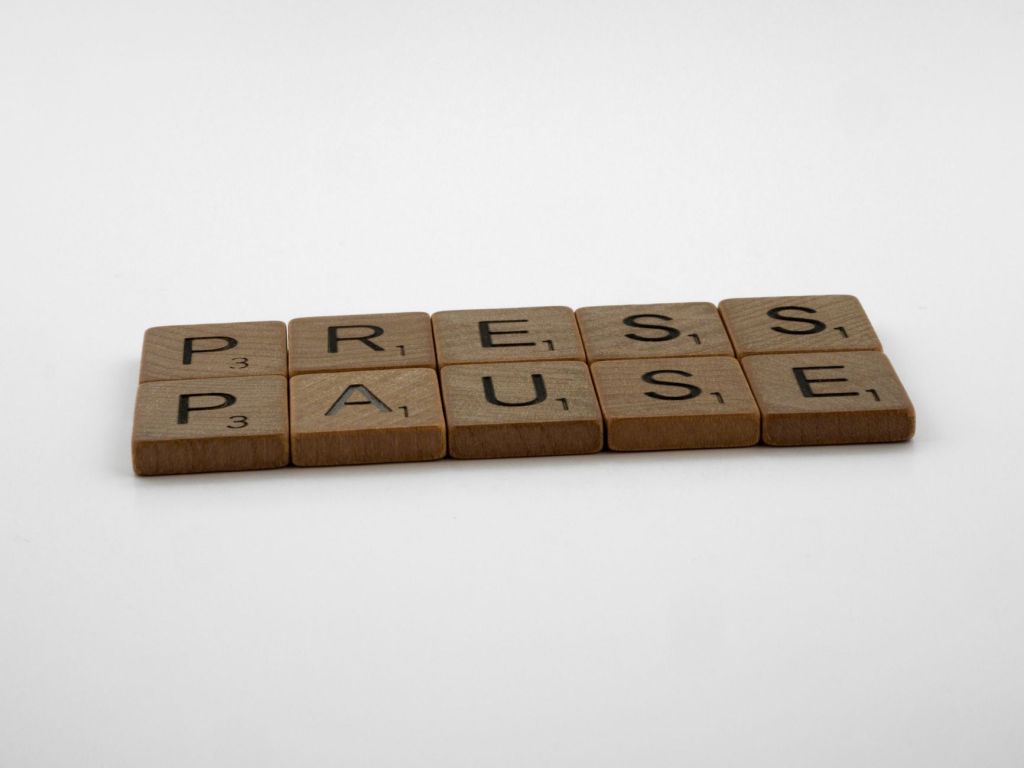
On the most consequential moment nobody talks about
(6 Minutes)
Something happens.
It might be small. An email arrives with a tone you didn’t expect. Someone says something in a meeting that lands wrong. Your child does the thing you’ve asked them not to do three times already today. A driver cuts you off. A plan falls through. Someone takes credit for something that was yours.
Something happens — and then, almost immediately, something else happens. You respond.
The gap between those two things is where everything lives.
Most of us move through that gap so fast we don’t know it exists. The stimulus arrives and the response follows with the efficiency of a reflex — shaped by habit, by mood, by whatever happened in the hour before, by patterns laid down so long ago we’ve stopped noticing they’re patterns at all. The email gets the sharp reply. The child gets the raised voice. The meeting gets the defensive pushback. We respond from wherever we happen to be at that moment, which is often not where we would have chosen to respond from if we’d had a choice.
The thing is — we had a choice. We just moved through it too fast to use it.
That gap — that fraction of a second between what happened and what you did next — is not nothing. It is, in fact, the most consequential real estate in a human life. Viktor Frankl, writing from inside a Nazi concentration camp, called it the last of human freedoms: the ability to choose one’s response to any given set of circumstances. Not the circumstances. Not the outcome. The response. That choice, he argued, is the one thing that cannot be taken from a person regardless of what is done to them.
Most of us are not writing from a concentration camp. Our gaps involve emails and traffic and tired children and difficult colleagues. The stakes are lower. The principle is identical.
Here is what the gap actually looks like when you slow it down.
Something happens. Your nervous system registers it before your conscious mind does — a flash of adrenaline, a tightening in the chest or the jaw, a surge of whatever the situation produces in you. This is automatic. This is biological. This is not a character flaw.
Then — in the space of a breath, sometimes less — there is a moment. It is genuinely there, even when it doesn’t feel like it. A moment where the automatic response hasn’t yet been executed. Where the words haven’t yet been said. Where the action hasn’t yet been taken. Where you are, briefly, between what happened and what you do about it.
That moment is yours. Not always. Not in genuine emergencies where speed is survival. But in the ordinary provocations of an ordinary day — the ones that produce outsized responses, the ones you later wish you’d handled differently — it is almost always there.
The practice is simply learning to find it.
This is harder than it sounds. Not because the gap is difficult to use once you’re in it — once you’re actually there, in the pause, the better response usually announces itself without much effort. It’s harder because the gap is so short, and because the habitual response has so much momentum behind it.
Think about the last time you sent an email you later wished you’d sat on for an hour. The last time you said something to someone you love that you immediately wanted to take back. The last time you reacted to a situation from the worst version of yourself rather than the one you actually want to be. In almost every case, there was a gap available. A breath. A pause. A moment where a different choice was possible.
You just didn’t take it.
Not because you’re weak or undisciplined. Because the gap is short and the habit is fast and nobody ever explicitly told you that what happens in that fraction of a second determines more about the quality of your life than almost anything else you will do today.
The people who seem to move through difficulty with unusual grace — who don’t seem rattled by the things that rattle everyone else, who respond rather than react, who make you feel steadier just by being in the room — are not people without reactions. They have the same nervous system you have. The same flash of adrenaline. The same tightening.
What they have learned, through practice or necessity or some combination of both, is to find the gap. To locate that fraction of a second and actually inhabit it before moving through it. To let the automatic response arise — because it will always arise — and then make a choice about whether to act from it.
That choice is available to you in every difficult moment of every ordinary day. It requires nothing external. No special circumstances. No permission from anyone. Just the willingness to slow down enough to find what was always there — the pause between what happened and what you do next.
It is smaller than you think. And it is enough.
Between the thing that happened and the thing you do about it — there is a moment. That moment is yours.


Leave a comment